
Physio Referrer Online-
Directional Preference Exercises for Low Back Pain: Helping your patient get control of their symptoms
Low back pain remains the most common presenting problem to our practice and includes a number of common clinical presentations as well as the occasional serious or specific problem (fracture, cauda equina syndrome, bony metastases). With this in mind, it is important we are able to help your patient with back pain get control of their symptoms and start to move normally. In this issue of Physio Referrer, we review directional preference exercises for low back pain – what they are, how they work and what to do when the textbook exercises DON’T work.
Directional Preference: A powerful tool
Directional Preference is a concept developed by the late Robin McKenzie, New Zealand physiotherapist who pioneered and developed Mechanical Diagnosis and Therapy (MDT). Directional preference refers to the clinical phenomenon where a specific movement or exercise reduces, centralizes or abolishes your patient’s symptoms. This involves tracking your patient’s symptoms closely as they move carefully but repeatedly in one direction. Commonly, there is a correlation between your patient’s symptoms reducing (or centralizing) and their range of movement improving.
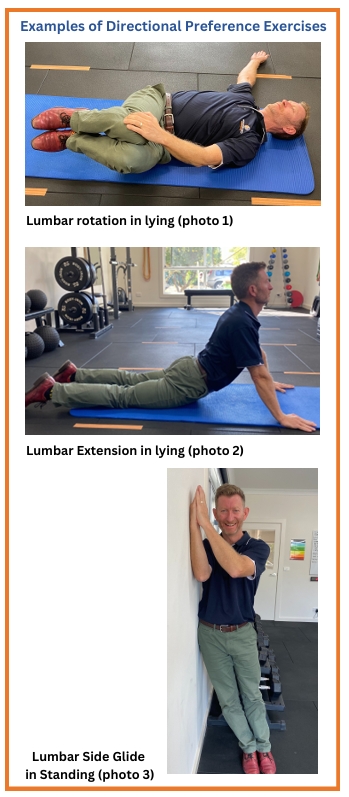
Common Directional Preference Exercises for Low Back Pain
Undoubtedly, the most common directional preference exercise we prescribe is lumbar extension (photo 2). This exercise can be done in lying or standing and is useful for patients with central symmetrical symptoms (no radiculopathy) and whose problem is aggravated by flexion activities (sitting, gardening, repetitive lifting). Patients who fit this pattern often respond quite rapidly, reporting significant improvement as early as Session 2.
A second common directional preference exercise is side glide (photo 3). This exercise is useful for patients with unilateral symptoms, but no radiculopathy. Side gliding is particularly useful for patients who have a lateral shift as part of their clinical presentation.
A third directional preference exercise is flexion and rotation (see photo 1). This exercise is required for patients with unilateral symptoms who are worse with extension or side gliding, and is useful in an acute patient with radiculopathy.
How do Directional Preference Exercises Work?
The theoretical basis for directional preference is the concept of articular derangement – displacement of articular material, of whatever nature, causes pain until that displacement is reduced. For low back pain, our model is based around disc derangement. Theoretically, the exercise “reduces” the internal joint derangement, improving range of movement and reducing pain. From a practical prospective the main thing is the exercise reduces, centralizes or abolishes your patients symptoms, either during the session, or at least over 2-3 sessions.
What do we do when the basics don’t work?
As mentioned above, there are common directional preference exercises for common clinical presentations. The majority of back pain patients report success with these simple but powerful exercises, but what do we do when the textbook exercises DON’T work?
The first solution is to progress the basic exercise. Sometimes this involves guiding your patient to move further into range – asking them to use their full available movement. A second option is force progression – adding a little more force to the exercise to achieve full range of movement. A third option is to add a lateral component to a sagittal plane exercise – encouraging more movement through one side of the lower back. Fourth, sometimes an alternative position produces a different response, whether it be performing their exercise in lying, sitting or standing. All of these options help to shift things from having no effect on your patient’s symptoms to having a positive effect.
In Summary
Directional Preference Exercises are a powerful tool for reducing your patient’s back pain and helping them get back to their normal activities. The selection of which exercise, which position to do it in and how much force to apply are all variables to consider. These exercises not only help to reduce your patient’s symptoms – they put your patient in charge of their rehabilitation – a win-win for a problem that is known to be recurrent.